
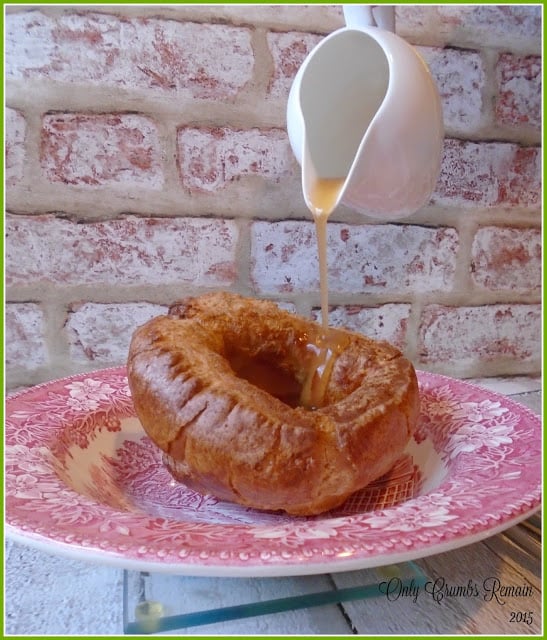
Being a Yorkshire lass, the home of the fabulous Yorkshire Pudding, I thought it was about time that I included these beauties on Only Crumbs Remain! However, rather than simply whipping up a batter and baking them in the oven, I thought I'd share it as one of my Side-by-Side Baking features Firstly, for those of you who may not have come across Yorkshire Puddings before, they are made from a simple batter of flour, egg, milk and a pinch of salt to season. The mixture is akin to that of pancakes / crepes but is a little thicker. The batter is then baked in a hot oven, where it puffs up to create a wonderfully light and crisp savoury addition to a traditional Sunday roast. They can also be made into a 'toad-in-the-hole' (Yorkshire Pudding baked with a sausage in the centre) or even served as a dessert with jam and cream, though I must admit that that doesn't particularly float my boat. They can be baked in any size of metal bakeware, be it a small muffin size tin to create individual puddings, which seem to be more popular these days, through to large roasting tins which allow the pudding to be sliced up and shared amongst guests.
Grandma, another Yorkshire lass who was born in a beautiful village in the North Yorkshire Moors, made fabulous Yorkshire Puddings, though, of course, it's not a prerequisite to hail from this neck of the woods to make them well 😉 She often made hers in a large roasting tin and being so large it was sliced up and shared amongst the five of us as a starter with lashings of gravy made from the meat juices of the beef she had lovingly roasted. I must admit, even now when I've not consumed beef for many many years, the memory of her Yorkshire Puddings served with the beef gravy is fondly engraved in my memory for its deliciousness.
I clearly remember helping Grandma as an 8 or 9 year old to whip up the Yorkshire Pudding batter and then setting it aside until it was ready to be cooked. It was always set aside. Covered with a plate, no cling film in those days, it was left to do 'its thing', what ever that was. Even now, many years after Grandma left us, we still rest the batter for a good couple of hours.
Given that you may be planning on whipping up a Yorkshire Pudding batter to serve alongside your other trimmings this Christmas, or perhaps for a regular midweek meal as a 'toad-in-the-hole' I thought I'd look at the effect of resting a Yorkshire Pudding batter.
So, how did I go about it? I baked two batches of the puddings. The first was not rested at all, the second was rested for two hours. I set a baking tray, with a little oil in the hollows, in a hot oven. Once the baking tin and oil was very hot I made one batch of batter, of sufficient quantity for both bakes. This ensured the mixture was identical for both batches, only the resting period changed. Part of the freshly made matter was poured into the hot tray and baked. Unfortunately, due to the heat of the baking tray I was unable to measure the batter into the tray, so I judged them to be a third full by eye. The remains of the batter was covered and set aside for two hours before that was baked in the same manner.
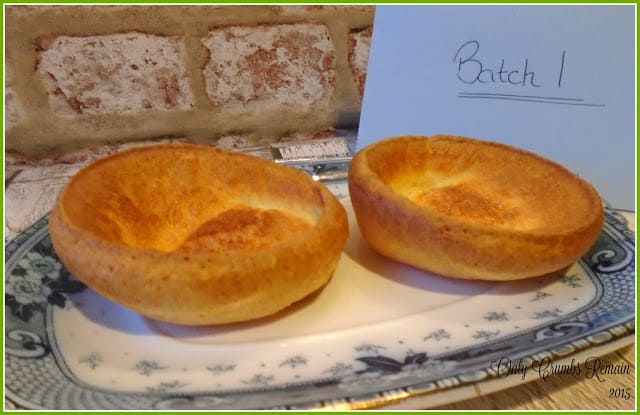
And the results. Well, to be honest I think the images speak for themselves. Batch one, which had had no resting period, came out almost as flat as a pancake! They were disastrous. I was so glad they weren't being served to any guests! Batch two, which had been rested for two hours, was far more successful, I'm sure you'll agree. They had risen beautifully. To be honest they smelt far more delicious than the first batch too. Now this may have been a psychological reflex given how much more inviting they looked, after all the look of food plays a vital role in our eating experience. Though, who knows, there may be an actual reason for the inviting aroma having left it to rest for two hours. (You will also notice that the pudding to the left of the 'batch 2' image was somewhat larger as I had overfilled the baking tray, so the right hand pudding was used for the side-by-side image which was far more comparable in terms of the amount poured into the baking tray.)

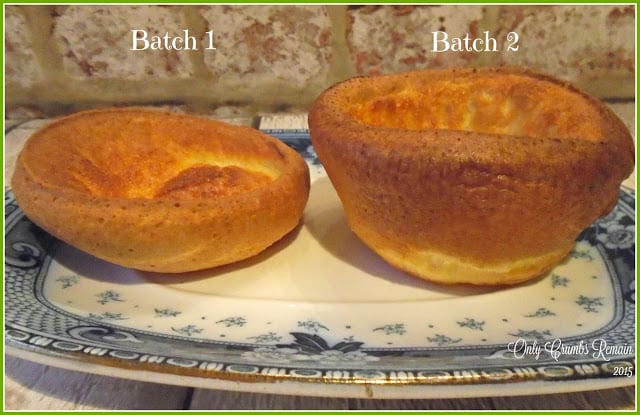
Clearly the resting period is of significance. I would love to share with you the definitive reason why the batter needs to rest. Sadly I can't, even after conducting a few searches on the net. Although the egg and heat play an enormous role in ensuring the batter rises, as no other raising agent is used, I had wondered if the resting was connected with the action of the gluten which had been worked during the beating, but our elderly neighbour who is a retired chef tells me that the resting allows the mixture to ferment which in tern gives more rise to the puddings. He tells me he used to allow the batter to rest overnight when cooking for paying guests. Another search I carried out on the net was for other top tips when making Yorkshire Puddings and soon came across this page from BBC Good Food. Resting the batter and ensuring the baking tray and oil within is hot was listed several times. As was keeping the batter at room temperature.
Do you have any top tips for making Yorkshire Puddings? Do you perhaps know the actual reason why we should let the batter rest?
So let's get to it and bake.
Yorkshire Puddings Yum
Yield: 2 individual sized Yorkshire Puddings (it will make more in a muffin sized tin)
Serves: 2
Difficulty: Easy
Time: hands on time 5 minutes; plus resting time; 20 minutes bake time.
Freezable: Yes
You will need:
1 Mixing Bowl
Balloon or Egg Whisk
Sieve
Yorkshire Pudding Tray (each compartment measuring approx. 10cm in diameter) or Muffin Pan
Pyrex Jug
For the batter
1.5 tbsp. Plain Flour
pinch Salt
1 medium Egg
70ml Milk
Vegetable Oil / Dripping / Lard
How to make them:
1. Make the batter. Place the flour and salt into the bowl. Add the egg. Use a balloon or egg whisk to combine the flour with the egg to make a thick smooth paste. Slowly add the milk, whisking it into the flour mixture. You may not need all of the milk. You're aiming for the batter to be lump free and the consistency of double cream.
2. Rest the batter. Cover the bowl and set aside to rest. Rest the batter for at least half an hour, though ideally for as long as you can (up to 24 hours).
3. Pre-heat the oven to 240c / Fan 220c / Gas 9.
4. Heat the baking trays. Add 2 teaspoon of oil to each of the baking tray holes. Place the trays in the oven, just above half way up. Allow them to heat up for at least 10 minutes.
5. Prepare the batter. Whisk the batter again for 30 seconds with the balloon / egg whisk. Pour the mixture into a Pyrex jug (or similar).
6. Bake the Yorkshire Puddings. Working quickly (but safely) to avoid loosing too much heat from the oven, remove the baking tray from the oven. Close the oven door to keep the heat within. Carefully swirl the tray a little to ensure the oil is covering all of the baking tray hollow. Pour the batter into the moulds so that they are a third full. It should sizzle. Place the tray back into the oven. Avoid re-opening the oven door whilst the puddings bake. If using a Yorkshire Pudding tray bake for 20 - 25 minutes depending upon how crisp you like them. It will take slightly less time in a muffin pan as they are a little smaller.
Enjoy with lashings of your favourite gravy!

Helen - family-friends-food says
What a difference! I'll be sure to make my batter well ahead of time in future 🙂
The only other thing I could think of that might need the resting time is the absorption of liquid into the flour. I've no idea whether the level of hydration of the starch makes any difference to the rising, but that was the first thing that came to my mind. Whatever the reason, I think the results speak for themselves!
Angela - Only Crumbs Remain says
Ooh that's a really interesting theory Helen, resting the batter is sure the way to go 🙂
Thanks for popping by and commenting,
Angela x
Charlotte Oates says
Wow I can't believe what a different resting the batter makes in your test. I've sometimes rested my batter and sometimes put it straight in and never seen a huge difference (although I've never done it all at the same time to test side by side so there may be a difference). I wonder if it's down to differences in the recipe as I use less milk and more flour than you've used here.
Angela - Only Crumbs Remain says
It's amazing isn't it, I thought it would have been marginal but, as Bucks Fizz sang "the camera never lies" 🙂 and just such a marked difference. It may have something to do with the thickness of the batter Charlotte, who knows, as even the net surfing I did showed people have different recipes. That could form a Side-by-Side baking experiment. I must admit that I don't usually weigh my flour & milk when making Yorkshire Puddings and Pancake batters as I go with the feel of it through the whisk as my Grandma taught me - but that is very difficult to describe so I simply weighed as I went along until I got a batter that I was happy with.
Thanks for popping by and commenting Charlotte, and of course for hosting,
Angela x
Mandy says
Thanks for doing this experiment. I've often wondered why you need to rest the batter - for yorkshires and for pancakes - but I never would have got around to finding out! I think we might have toad in the hole for dinner this week now, you've inspired me. Thanks for linking up with #CookBlogShare x
Angela - Only Crumbs Remain says
Ooh delicious choice for dinner, perfect for this miserable weather!
Thanks for popping by and commenting (and for hosting),
Angela x
Martin @ The Why Chef says
Love this post so much! Right up my street, both in context and as Yorkshire puddings are the bomb! Plus I love a good experiment, me!
A good way to test if it is the gluten that plays a part in the extra rising is to do the same test using bread flour, as this forms stronger gluten bonds.
The fermentation is also definitely a part I'd say, as sourdough starter is just flour and water left to ferment. All them extra bubbles from the fermentation definitely add lift!
Angela - Only Crumbs Remain says
Thank you Martin 🙂 I've added the bread flour suggestion to my list 'to do' list.
Thanks for popping by and commenting,
Angela x
Rebecca Beesley says
wow - what a difference - i thought you had used a different recipe for each as the difference is so vast. A friend of ours swears by adding extra eggs to the mixture - although 1 extra egg seems to help, whenever i try more than that as he suggested it doesnt seem to work out at all going too soggy. Seems like resting is the answer - which i never do so i shall start to.
Angela - Only Crumbs Remain says
I was shocked too by the difference Rebecca to be honest. Some of the tips I came across on the net when writing this suggested using plenty of eggs as it's the eggs which really provide the lift - that said the resting must be doing something to help. I'd definitely recommend resting them, I know so many family and friends who advocate it.
Thanks for popping by and commenting Rebecca,
Angela x
Eb Gargano says
Wow! Who would have thought resting Yorkshire pudding batter could make quite so much difference?! Love your side-by-side experiments. Can't wait for the next one! Eb x
Angela - Only Crumbs Remain says
I was surprised by how much difference there was too! Just goes to show that Grandma knows best 🙂
Thanks Eb, I have a list almost as long as my arm for my Side-by-Side features!
Thanks for popping by and commenting,
Angela x
Mrs Tubbs says
I so want to go home and make Yorkshires now! Those do look yummy
Angela - Only Crumbs Remain says
Hahaha 🙂 I'd not recommend making batch one though 😉
Thanks for popping by and commenting,
Angela x
charlotte ratcliffe says
Wow look at the difference! I love your experiments it outlines things so you can really notice the differences! thanks for sharing - I have shared them too! Found you through #TastyTuesday
Angela - Only Crumbs Remain says
Thank you Charlotte. I love baking and having always stuck to the taught methods I've been intrigued to see what happens when different principals are applied or if a stage is missed out (like the resting with the Yorkshire Puds).
Thanks for sharing Charlotte and for popping by and commenting 🙂
Angela x
woodenwindowsills says
I've always made my batter early and rested it too, but I have no idea why, or even that it produced better Yorkshires! I proudly made a roast for Adam's family the other day and they came out beautifully which was great as they couldn't believe they could be so light and tasty, being lovers of the frozen pre-made Yorkshire puddings (which I think is utter sacrilege!) They're so easy to make, I don't understand why people choose to buy factory produced! Alice xx
http://www.woodenwindowsills.co.uk
Angela - Only Crumbs Remain says
Home made Yorkshire Puddings all the way Alice, they're so quick and easy to whip up. I hope you shared with your inlaws how easy they are to make 🙂 The resting certainly did produce better Yorkshires, and not simply to look at - the taste and aroma of them was markedly better (though I'm still unsure why).
Thanks for popping by and commenting,
Angela x
belleau kitchen says
Hey Angela, I love these kind of comparison things and I adore Yorkshire Puddings so I will be trying your batch 2! Thanks so much for linking to Simply Eggcellent, it would be amazing if you could put a link on your blog and the badge too! Thanks x
belleau kitchen says
oh and then it appeared! Ignore last message! xx
Angela - Only Crumbs Remain says
Yorkshire Puddings are just great aren't they, yes Batch 2 is certainly the way to go 🙂
Thanks for hosting Dom,
Angela x
Anonymous says
I've never made Yorkshire Pudding (it's on my bucket list!), but I will be definitely giving them a rest like you recommend!
Saskia / girlinbrogues.com
Angela - Only Crumbs Remain says
Ooh you're going to have to remedy that Saskia, they're so easy to make and delicious to eat 🙂
Angela x
Jasmin Charlotte says
That is quite the change!! I love Yorkshire Pudding and toad in the hole, both super delicious! x
Jasmin Charlotte
Angela - Only Crumbs Remain says
It really is isn't it. I was really surprised by how much difference there was between the two batches. They're super delicious aren't they.
Thanks for popping by and commenting Jasmin,
Angela x